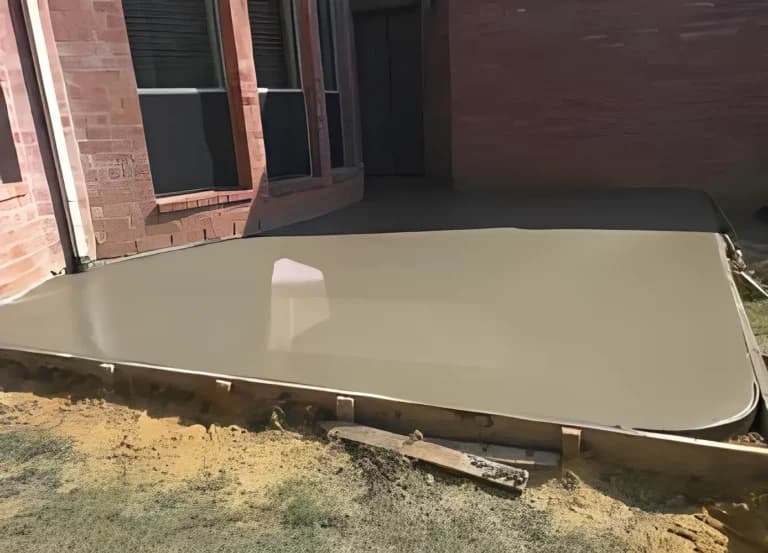
Garage & Workshop Slabs in Holly Springs, NC
Professional garage & workshop slabs for homeowners in Holly Springs, Wake County. Free written estimate.
Expert Garage & Workshop Slabs in Holly Springs, NC
Detached garage slabs and workshop pads sized for point loads. 12-inch turndown perimeter to meet NC frost-line minimum.
Holly Springs is a Wake County town just north of Fuquay-Varina on similar Cecil-Appling clay soil, but with more Enon-Iredell diabase intrusion in the northeastern neighborhoods around Sunset Ridge and 12 Oaks. That diabase soil has substantially higher bearing capacity than Cecil clay but also shrinks more aggressively during drought, which drives specific footing depth requirements. For foundation work in Holly Springs, all pours meet the 12-inch minimum NC frost line depth for continuous footings, with #4 rebar at 16-inch centers longitudinal and 24-inch centers transverse per NC Residential Code R403. Monolithic slabs for garage and workshop pads get a 12 to 16-inch turndown perimeter thickened edge. Holly Springs permit and zoning approval runs through the town Development Services office on West Ballentine Street; setback verification and erosion control are enforced by Wake County. Additions tied into an existing home foundation require a doweled connection with epoxy-set #4 rebar every 24 inches, both to transfer load and to prevent independent slab movement. In older Woodcreek and Bass Lake neighborhoods, we frequently encounter existing footings that were poured shallow to 1970s standards, and we retrofit with epoxy-injected pier extensions rather than full replacement when the existing concrete is still structurally sound.
How we build in Holly Springs
Residential concrete foundation work in Fuquay-Varina and across Wake and Harnett counties requires attention to two things most contractors skip: subsurface soil behavior and NC Residential Code compliance. The Piedmont region sits on Cecil-Appling clay and Wedowee silt loam over decomposed granite saprolite. That subsurface profile swells during long wet stretches and shrinks during summer drought, which drives the expansion, contraction, and differential settlement that causes 90 percent of residential foundation failures. Our foundation crews design every pour around that soil behavior. New slab-on-grade foundations begin with subgrade preparation removing organic topsoil to expose stable inorganic soil, followed by 4 inches of compacted ABC crushed stone at 95 percent standard proctor density, a 6-mil vapor barrier under the entire slab, and a 4-inch minimum slab thickness with a thickened turndown edge extending to the 12-inch NC frost line minimum per the 2018 NC Residential Code section R403.
Reinforcement is #4 rebar tied on 16-inch centers per NC Residential Code section R506, with intersections wire-tied and chair-supported at mid-slab depth. The concrete mix is a 3500 PSI residential design with entrained air for freeze-thaw exposure. Curing follows the ACI 308 recommended schedule: 24 hours before foot traffic, 7 days before load, 28 days for full design compressive strength. We control the cure with wet burlap, plastic sheet, or ASTM C309 curing compound depending on ambient temperature and forecast conditions. Fuquay-Varina, Holly Springs, and Apex all have busy planning offices, and we schedule inspection 24 to 48 hours in advance to keep the pour timeline moving.
Addition footings are our most common Wake County project. When a homeowner adds a screened porch, sunroom, or bedroom, the new foundation has to tie into the existing home footing without causing differential settlement between the old and new. Every addition footing on our schedule includes a doweled cold joint with #4 epoxy-anchored rebar every 24 inches, transferring load properly and controlling movement. Continuous footings extend below the frost line, and we always verify the existing footing depth by hand excavation before designing the new pour. Older homes in Fuquay-Varina, Angier, and Willow Spring sometimes have shallow 1960s or 1970s footings that were poured before NC frost-line requirements were codified, and those require a deeper new footing rather than matching the old shallow one.
Garage slabs and workshop pads are the second most common project. Detached garages and workshops on Wake County acreage typically fall between 400 and 1,200 square feet. Every slab includes a compacted stone sub-base, thickened turndown perimeter, #4 rebar on 16-inch centers, and a 4-inch slab minimum at 3500 PSI. Point-load areas under column pads, lift positions, or heavy equipment get thickened isolated pads. We coordinate with the general contractor or the homeowner directly to time the pour before framing arrives on site.
Crawl space pier repair is common on older homes in Fuquay-Varina, Angier, and Willow Spring where the original piers have settled or spalled. We diagnose the cause, whether soil movement, moisture damage, or original construction shortcuts, and replace only the piers that have failed rather than the entire crawl space. Every replacement pier is a minimum 8 by 8 inches with a footing extending below the 12-inch NC frost line and reinforced with #4 rebar. Wake County and Harnett County both require permits for structural pier replacement, and we handle the paperwork.
Ready to get started in Holly Springs?
Free estimates — no obligation. Response within one business hour.
Garage & Workshop Slabs in Holly Springs — project photos
Garage & Workshop Slabs — Holly Springs FAQs
How much does garage & workshop slabs cost in Holly Springs?
Residential concrete foundation work in Fuquay-Varina typically runs $6-$14 per square foot depending on soil conditions, slab thickness, and reinforcement schedule. Pricing bands sourced from HomeAdvisor 2026 concrete cost data.
How long does garage & workshop slabs take in Holly Springs?
Typical 3-7 days on site for a residential project.
Do you handle permits and inspections in Holly Springs?
Yes — every project includes permit paperwork through the Holly Springs planning office and coordination of the required Wake County inspections.
What soil type do you work in around Holly Springs?
Holly Springs sits in NC's Piedmont region on the Cecil-Appling clay and Wedowee silt loam soils typical of the area. Every pour is designed around that soil behavior including base preparation, reinforcement schedule, and joint spacing.
Are you licensed and insured?
Yes. NC general contractor license, full liability, and workers comp. We can provide the certificate before work starts.
Serving Holly Springs, NC
Fuquay Foundation Co. serves Holly Springs and surrounding areas including Fuquay-Varina, Angier, Apex, Willow Spring.
Garage & Workshop Slabs in nearby towns
Other services in Holly Springs
Get your free garage & workshop slabs estimate in Holly Springs
Fuquay Foundation Co. — response within one business hour, every day. Written on-site estimate.